 Copyright
(C)2004 by Steve Litt. -- Legal
Copyright
(C)2004 by Steve Litt. -- Legal
| October 27th, 2002 Although I have maintained vsound for nearly three years, I can no longer do so, nor can I continue to make it available from this web site. I live in Australia which has a law (Digital Agenda Bill 2000) which is similar to the DCMA in the US in that it makes the distribution of a devices for circumventing copyright protection illegal. I have neither the time, money or inclination to make myself a possible target for such legal action by companies with endless legal and financial resources. However, vsound is probaly available from other web sites. If you want a copy, you should search the web. Do not email me as I cannot and will not provide you with a copy. Erik de Castro Lopo. |
|
NOTE:
Throughout this document, all examples assume that the original .ra file(s) was encoded at 11025 samples per second. |
esd -r 11025 -d /dev/dsp
esdmon | sox -r 11025 -v2 -c 2 -t raw -w -s - -t wav - | oggenc -r --resample 11025 -o out.ogg -
|
NOTE:
Throughout this document, all examples assume that the original .ra file(s) was encoded at 11025 samples per second. |
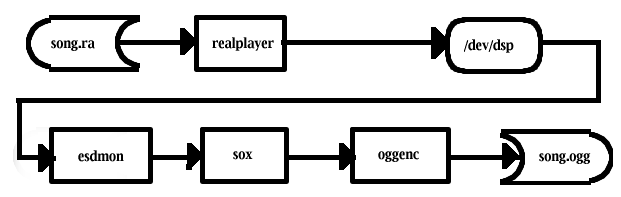
The preceding sends esd output to the /dev/dsp device. The -r 11025 specifies that it will be sampled at 11025 samples per second. It is vital that you make this number match the sampling rate of the .ra files. If the number is lower than the sampling rate of the .rafiles, you'll lose high frequencies and crispness. It it's higher than the.ra files, the computer's software will try to sample where no samples exist. At first glance this might seem a great way to enhance highs for an inadequately recorded .ra file, but what it really does is interpolate the existing, gettting some of it right and some of it wrong. This is very much like zooming in on a low resolution picture -- you don't get a better picture -- you get pixelation. In this case, if the number is greater than the sampling rate of the .ra file, you get harsh high frequency distortion coupled with a distracting resonance.
esd -r 11025 -d /dev/dsp
esdmon | sox -r 11025 -v2 -c 2 -t raw -w -s - -t wav - | oggenc -r --resample 11025 -o $1 - |
| sox
arguments and options |
oggenc arguments and options | ||||||||||||||||||||||||||||||
|
|
esd -r 11025 -d /dev/dsp
esd -r 11025 -d /dev/dspThen run realplay. It should now play its opening welcome message, and should be able to open and play other .ra programs.
[esd] |
[esd] |
esdBe aware that the preceding is a coathanger solution, and like all coathanger solutions that "fix" the symptom rather than eliminating the cause, it will cause side effects on all other programs using ESD. Therefore, once you've converted your .ra files, be sure to restore /etc/esd.conf from backup. If you desire, you can save the tweaked file as /etc/esd.conf.ra2ogg.
| Rate |
Divisor |
Fidelity |
Comments |
| 44100 |
44100/1 |
Full fidelity |
CD quality |
| 22050 |
44100/2 |
half rate |
You'd need good ears to discern the decreased quality |
| 16000 |
44100/2.75625 |
Probably won't convert well at this rate |
|
| 15876 |
44100/(25/9) |
custom divisor |
|
| 14700 |
44100/3 |
third rate |
Decreased highs, but still enjoyable |
| 11025 |
44100/4 |
fourth rate |
Lowest sample rate enjoyable as music |
| 8820 |
44100/5 |
fifth rate |
Good, understandable speech |
| 4410 |
44100/10 |
tenth rate |
Muffled speech, but reasonable understandable. A little worse than telephone quality. Consonants such as S and F cannot be discerned except by context. |
esdmon | sox -r 11025 -v2 -c 2 -t raw -w -s - -t wav - | oggenc -r --resample 11025 -o $1 - |
FN=$1 |
./esdmon.sh mysongLook closely at the do1.sh script. Notice that for each song, it runs esdmon.sh in a terminal in the background, and then runs realplay, on the appropriate .ra song, in the foreground. Thus, the conversion script is guaranteed to be running before the song starts in realplay, thus preventing elimination of the front of the song. However, the only way to stop esdmon.sh is to Ctrl+C the terminal BEFORE closing realplay. If you had closed realplay before terminating the terminal, you'd have gotten multiple terminals, and who knows what that would have done to your audio.
./do1.sh mysong |
|
See also: [ Linux Library | Troubleshooters.Com | Email Steve Litt | Copyright Notice ]
Copyright
(C)2004 by Steve Litt. -- Legal